Pages

Showing posts with label coming-of-age. Show all posts

Thursday, May 10, 2018

Aru Shah and the End of Time (Pandava Quartet #1) by Roshani Chokshi

Saving the world and fighting a demon sounds easier than dealing with school and friends for Aru Shah. Her constant push to try and fit in has meant exaggerations and lies to classmates. When a trio of 7th graders show up at the Museum of Ancient Indian Art and Culture where she lives with her mother to see if she is in Paris for the holidays, she has to do some quick lying again; however, her classmates ain't buying it. The bullies are convinced that Aru doesn't belong at their elite prep school where fancy cars and exotic trips are the norm. Her world involves taking care of herself while mom is off on trips and giving museum tours for fun.

When the classmates dare Aru to light a cursed antiquity lamp she ends up awakening the Sleeper... oops. She thinks of her mom's warning to not light the lamp, like those “generic warnings parents gave to kids, like 'Don’t go outside without sunscreen or you’ll burn!' Or, as the woman who ran the local Hindu temple’s summer day camp liked to remind Aru: 'Don’t go outside without sunscreen or you’ll get darker and won’t find a husband!' Until it happened, who cared? Aru had never gotten sunburned, and she really didn’t need to find a husband at age twelve." She didn't really believe her mom and had no clue she'd have to battle a demon. Great dialogue, fast pacing, funny gods and hysterical characters make this a winner for fans of Rick Riordan's books. Roshani Chokshi's uses familiar fantasy tropes and much of the humor is a parody of hero narratives while following the monomyth. A laugh-aloud middle-grade adventure using Indian mythology.

After lighting the lamp everyone freezes and a guardian who helps Aru on her quest comes in the form of a snarky pigeon. The author is poking fun at several fantasy tropes. Here the guardian is in a frail body and frustrated that he has to mentor a young girl. Aru is the reincarnated soul of one of the Pandava brothers from the Indian epic poem, Mahabharata; however, she lacks the wisdom and athleticism found in the poem's male heroes. Aru thinks of the pigeon as a “rat with wings” and is not impressed by him either. Meanwhile, the pigeon knocks her for being a kid hero and sees the world ending versus her saving it. When she looks at her frozen mom and classmates asking if they would be stuck that way, the pigeon answers: “It’s temporary,” said the bird. “Provided you aren’t riddled with ineptitude.” “In-ep-tee-tood? Is that French?” The bird knocked its head against the wooden banister. “The universe has a cruel sense of humor,” it moaned. Aru may be green when it comes to quests but she proves her bravery as the plot moves forward.

When Aru links up with another reincarnated soul it comes in the form of Mini, a slightly neurotic girl obsessed with germs, Oreo cookies, and death. When Mini shoves an Oreo cookie into Boo's mouth he says, “What ambrosia is this?” He smacked his beak. “Gimme more.”Mini quotes dictionaries and medical books and can't believe she was chosen for the quest instead of her brother. She diagnoses Aru when she talks back to Time explaining that Aru has “Type One Insufferable-ness.” Her character arc progresses from a kid who shrinks at danger to one accepting the inevitable task of saving the world. When Mini first meets Aru, she asks, “I hope you don’t have a bee allergy. I only have one EpiPen. But I guess we could share? I’ll stab you, you stab me?” The pigeon getting a double-dose of inept heroines does a face-plant asking "whyGodwhyme." The heroes embrace the poster-boy or girl image of a superhero from Aru yelling Batman sayings, wearingSpider-man pajamas, asking Boo for capes, to elbow-bumping instead of fist-bumping with Mini. Germs on the fist, Mini points out, and Aru thinks capes are like blankies that bring comfort to superheroes.

Spoiler alert - okay... I might be telling too much of the story at this point. You could maybe read the next paragraph.


On their quest, they search for "celestial" weapons to help them save the world. They dream of magnificent, heroic swords to wield and instead get a bouncy ball and compact. Mini bangs her compact on the ground hoping it will start working during one scene where they are facing the enemy. When the weapons do activate the heroines have no control over them. They also remind characters throughout that they are heroines, not heroes. They are told that heroines are demanding and brave while the heroes let their magical sidekicks do all the work. Part of Aru's character arc is realizing that being overlooked and not considered worthy opponents could be used to her advantage. Their physical weaknesses are a strength. Plus, she's funny as she thinks stuff such as “And it stood to reason that if you were even a little bit divine, you should not have a unibrow.” She also learns that heroes doubt themselves. At the climax, she discovers that the definition of heroism was fighting for the people she cared about in the world.

Spoiler... I think. The next paragraph might be okay too.  Can you tell I don't quite recognize if I'm spoiling it for the reader?

While the author uses Indian culture and mythology, I kept thinking of Western folktales as well. There was an east-west blend for me. Parts reminded me of the Phantom Tollbooth ...perhaps because they end up in a tollbooth. Actually, the puns, word plays, and wit are what reminded me of it. From Polly Esther to the "-allys" it is pretty funny. Or the scene where the dead speak sentences backward because they can no longer go forward. Their third test is to get the celestial keys and one of the trials is to take a bite out of adulthood which Aru does literally when she finds a book titled, “Adulthood”. I like the imagery of a young protagonist that is coming-of-age taking a bite out of adulthood literally and figuratively. Great chapter headings such as “#1 on Mini’s Top Ten Ways I Don't Want to Die List: Death by Halitosis" add to the humor along with pop culture references such as Johnny Cash. Aru wants to nickname the bird "Sue", short for Sabula, but he says he is male. She asks if he's heard Johnny Cash's song, "A Boy Named Sue" which is about a boy named, Sue, who goes to kill his dad for naming him a girl's name only to find out that the dad said he named him that to make him tough. She settles on "Boo" for a nickname.

Okay, stop! Now I am definitely spoiling the story. If you have a great memory you might not want to read on.

The legend of Shukra is the author using her own creative powers that mixes folktales. Aru and Mini must cross the Bridge of Forgetting that is guarded by Shukra, a man cursed for killing his wife out of vanity. He is surrounded by mirrors as protection against memory-stealing snowflakes and anyone that wants to cross must give him all their memories or fall into the "fires of hell and be forced into the next life". He is a metaphor for the choices people make in life. He does not want to break the mirrors because bad karma will follow him into the next life. As he begins to steal Mini and Aru's memories, Aru goes after him but is cursed in the process. He reminded me of Marley in "A Christmas Carol" who forged long chains through greed. Shakru's "chains" are his mirrors and vanity led to him murdering his wife. He discusses being robbed of the past, present, and future. He's talking about karma but I kept thinking of the ghosts of Christmas past, present, and future. It's the same idea. The mirrors also reminded me of the Snow Queen and shards of glass that cursed the children in the story. Here, Shakru curses Aru as he moves on to reincarnation.

Aru's character arc involves coming to terms with her lies that are good and bad. She tells Mini the truth for the first time when she is exposed for not telling Mini she lit the lamp in the first place. Aru realizes that she lies to imagine “the world as it could be and not as it was.” She pulls out Adulthood coin upon this realization showing her growing up and coming-of-age. When Mini rejects her in anger at lighting the lamp, Aru reacts with courage and anger. She doesn’t roll over. She thinks about stories and how they are told: "The truth of  a story depends on who is telling it." She can write her own narrative. 

In another trial at the Palace of Illusions, Aru must escape her fears of being abandoned by her mother and being alone. She thinks, “People are a lot like magical pockets. They’re far bigger on the inside than they appear to be on the outside.” The Palace is alive and creates an illusion where Aru thinks she will die. She has to look at herself to escape the illusion, a metaphor for having to realize that her illusions and lies stem from fears. I think. The idea isn't really hashed out enough. I do find the Palace represents childhood and what is left behind when becoming an adult. It cries and tries to keep Mini and Aru kids by giving them everything they wish for and playing with them such as riding bikes and eating ice cream. A child's imagination dims over time and that is worth crying over. The Palace gives the two girls a tile to remind them of it and "home". The tile can be a metaphor for adults who hold on to their imaginations and memories of childhood can be storytellers in society. The Palace says “It is better, perhaps, to be thought of as a fiction than to be discarded from memory completely.” Again, the ideas are not completely fleshed out and it is up the reader to put their own interpretation on the plot. I felt teased by many of the metaphors but thought some of the thoughts came up short. A fun and funny book.

4 Smileys

Friday, March 16, 2018

The Hate U Give by Angie Thomas

African American Starr Carter lives in an urban ghetto but goes to a prep school in the suburbs with white students. When she witnesses a friend, Khalil, murdered by a white police officer, she has to decide whether to speak out or not. This story has many themes from family relationships to police brutality to interracial relationships. The author creates an authentic voice in the protagonist with plenty of action and ideas to critique as a reader. Overall, the story is well-crafted with a few long-winded spots. If you want a look into the hood and the issues arising from it, I highly recommend this book.

The protagonist Starr, loves rapper Tupac Shakur, and weaves rap music discussions in with dialogue as a means of explaining oppression within the community. Tupac's father was a Black Panther and embraced Marxist ideology teaching Tupac that the capitalist system was responsible for the destructive nature of black communities. The activism of the Black Panther's is different than the activism that has evolved in hip-hop music. Tupac's songs give autobiographical details of his life that speak about his struggles against violence and unfair odds that are a social commentary on black life. His activism for change is through music; whereas, the author tries to be an activist through her character, Starr, giving a social commentary on institutionalized racism and poverty using ghetto narratives and metaphors.

The rose is a metaphor from one of Tupac's songs. Maverick, Starr's burly father, struggles to grow roses in his garden, but he keeps at it and nurtures them so that they keep surviving as the family moves. The conundrum of ghetto poverty and violence and Maverick's love for the community, his identity, and desire to change it is captured well. The black community has been fighting for equal rights since the civil rights movement while dealing with economic suppression and unequal treatment that makes it difficult to change the cycle of poverty. The only time the gangs unite is when they fight together against institutionalized police brutality. Tupac struggled with the ideology of capitalism knowing that it could improve his life but was also destructive to the black community. Capitalistic systems excluded blacks from participating equally through oppressive measures whether through the justice system or police.

Author Angie Thomas attempts to imitate rap artists, such as Tupac and his real-life street narrative in prose. Jason Reynold's in "Long Way Down" does the same thing using poetry. Derrick Aldridge in the article, "From Civil Rights to Hip Hop: a Nexus of Ideas", discusses how Tupac in the album, "Thug Life", comes to terms with capitalism believing that the underground economic structure of drug dealers, pimps, and gangs of the black neighborhood will always be functional if oppressed blacks are left out of the capitalist system. Because blacks cannot participate in the capitalist world, they turn to drugs and gangs as a way to deal with oppression; hence, when Khalil's grandma loses her job because of side-effects of having cancer he turns to selling drugs to support his family. His mom is an addict and he's trying to support his brother and grandma. Pride makes him not ask others for help and his only economic option is drug selling.

The dad, Maverick, was in a gang and gets out by taking the fall for a robbery and going to prison. His wife is the breadwinner in the family and they make enough money to send their kids to prep school. They could leave the neighborhood but Maverick doesn't want to. The father shows the conflict that many hip-hop artists sing about when they make money and get out of the hood. According to Aldridge, this growing black business class is trying to define strategies for future economic growth that will help these neighborhoods. These artists and Maverick (who runs a store) are now participating in a capitalist system and are trying to figure out strategies for the black community that moves from oppression to equal participation in society.

The interracial relationship between Starr and her white boyfriend, Chris, was a bit superficial for me. I thought "Americanah" and "The Sun is Also A Star" are two books that dig more deeply into the complexities of relationships and different cultures than this book. I am being somewhat nitpicky here and doubt my students would agree with me. Angie Thomas uses their relationship to introduce some of the issues of identity and does try to give it depth - like I said, probably too nitpicky. We are discussing this for book club and I can't wait to get the student reactions.

5 Smileys

Monday, July 3, 2017

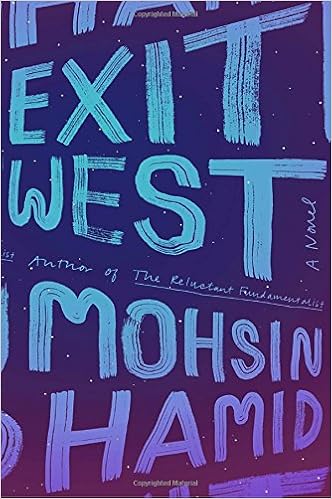
Exit West by Mohsin Hamid


Image result for exit westMohsin Hamid's, "How to Get Filthy Rich in Asia," imitated the style of a self-help book using the rarely used in fiction second person point of view. In "Exit West," Hamid again shows his willingness to take risks in a realistic story that uses metaphors and imagery that gives magical setting transitions a slightly surreal flavor. The magic places the readers' focus on the before and after flight of two immigrants fleeing a Muslim country in an unnamed war to countries that are hostile toward them upon arrival - it eliminates an exploration of the immigrants' journey. This heightened the psychological exploration of the immigrants for me, but some readers might not like the author's splat of magical realism. I listened to the audio book and Hamid's use of repetition and the excellent narrator made it memorable and easy to understand. "Exit West" is layered with many themes and timely as it reflects the current globalization, countries slant toward nationalism, and displacement of people from wars, to name a few. Some might like the romance, or the independent spirit of the female protagonist, different characters' struggles for self-identity, and a myriad of other topics. 


Saeed and Nadia, live in a Muslim country being overtaken by militants. They are progressive and enjoy modern technology until their city becomes overtaken by militants. Day-to-day living is replaced by anxiety and fear causing the retreat of people from public to private spaces to the point that they are afraid to go to funerals. When Saeed's mother is killed by a stray bullet people are afraid to come to her funeral and his father insists that Saeed and Nadia leave the city. Saeed's father will not go with them for he knows he will slow them down and he wants to remain where he's lived his whole life. He recognizes that his son has no future in a city were drones, killings, and bombs oppress everyday living. However, the father feels the past and its memories offer him more than the future and so he stays. The father and son know they may never see each other again.

When Saeed and Nadia immigrate through magical doors (literarily) to a refugee camp in Greece, then London, and the U.S., they encounter hostility from mobs of people who are "natives" that use violence against the newcomers. Saeed and Nadia are oppressed in their new homelands. They try to make their way and find an identity but it is difficult as an outsider. Their experiences show Saeed drifting to people like himself and how he finds comfort in their shared experiences and religion; whereas, Nadia drifts towards diversity and tries other clans. The two experiment with finding their identities. The end of the story shifts toward a romantic narrative and the previous plot tension gets a bit lost as the two go their own ways.

While the story is about migration and marginalization for Saeed and Nadia, it also reveals that people who live in the same place can feel like foreigners in their own city as well. Their home changes around them as can be seen in Saeed's father's lifetime. His city was mostly free and safe before militants started killing civilians and disrupting government operations. Two minor characters who fall in love at the end of the novel show a blending of those who migrate and those who stay in a city their entire life. Even though the immigrant does not know the language, he communicates through hand gestures with the man who has lived there his whole life. They fall in love and are happy revealing positive futures are possible where diverse people can coexist side-by-side without fear and hatred. The suggestion is that society is better or enriched when people can choose to live where they want and call home in whatever country they live. Fear and anxiety stunts not only the potential for an individual to live a full life, but also an entire society's.

Magical doorways are a metaphor for migration, globalization, and technology. The two people pass through doorways to Greece, England, and California. The author doesn't focus on the immigrants' journey; instead he examines where the protagonists came from and what happened after they arrived in their new countries. This exploration of displacement allows the author to focus on the psychology of what the characters are going through as they migrate. Not everyone will like the technique, but I thought the surreal moments enhanced the characters emotional turmoil of adapting to new situations and represented the unnameable displacement a person feels when uprooted from his or her home country. It's a bit like wading through a thick cultural fog.

The magical doorway metaphor reminded me of Skype and how I can live thousands of miles away from my loved ones and yet can see them on a computer and chat, just like a magic mirror in a fairy tale. For me, his book captures the international displacement I feel traveling the world. I haven't been home in twelve years and that seems to be a major point in the book. Not to mention, with technological advancements in computers, transportation and more, migration in today's global world is much more rapid than thousands of years ago.

Doors can also symbolize open and closed nations. Nations can close their borders by fear and wanting to live in the past like Saeed's father. Opportunities are open or closed to immigrants like Saeed and Nadia when they arrive in their new countries. Windows are another metaphor that the author uses that express the future as one with possibilities or not. The window in Nadia's apartment has beautiful views only to have to be covered as the threat of bombs sending shattered glass throughout the apartment grows. She describes the changes from a light apartment to one that is dark and where she and Saeed cower away from the window. There is quite a bit going on in this quick read and I've only touched on a few. I highly recommend it.

5 Smileys

Sunday, April 30, 2017

The Sun Is Also a Star by Nicola Yoon

Students chose this for book club and the snappy dialogue and defined characters make it a well-done interracial romance novel. Set in New York City, Natasha Kingsley, is being deported to Jamaica and trying to find a way to stay in America by contacting the US immigration office. Korean-American, Daniel Bae, is on his way to a college interview for Yale when their paths cross. When the two teenagers meet, the poetic Daniel tries to convince the logical Natasha that love at first sight is possible by asking a series of scientific questions. The author adds historical context that engages the reader whether it is an explanation of why so many Koreans own salons that cater to African Americans, immigration facts, scientific paradoxes, facts, theories, and more. 

Natasha is smart and has a clear view of the world. She won’t be patronized by adults and she’s blunt with people. At the immigration office, an adult tries to tell her the future will work out. “Don’t tell me I’ll be all right. I don’t know that place [Jamaica]. I’ve been here since I was eight years old. I don’t know anyone in Jamaica. I don’t have an accent. I don’t know my family there, not the way you’re supposed to know family. It’s my senior year. What about prom and graduation and my friends?” When Daniel meets Natasha he appreciates her direct, no-nonsense quality. Natasha is so science-driven that she explains the scientific chemicals that are released in the brain when a person falls in love trying to remove all the unexplainable romantic elements. 

Most of the alternating points of view are Natasha and Daniel’s, but there are side characters interspersed to round out the themes of self-identity, culture, love, science, and racism, to name a few. The poetic Daniel describes meeting Natasha and his love-at-first-sight is as follows: “It’s like knowing all the words to a song but still finding them beautiful and surprising”. While Natasha thinks of meeting him as definitely connecting with Daniel, but her practical side sees the moment and distrusts the “poetic heart”. “They’re not talking about the real heart, the one that needs healthy foods and aerobic exercise. But the poetic heart is not to be trusted.” Natasha doesn’t want to fall in love with Daniel.She will be deported in 24 hours. When Daniel saves her life and breaks her pink head phones that she's owned most of her life, it symbolizes her break with the past and all she has known. Her new cultural identity now involves interracial love and living in a new culture. 

While Natasha and Daniel don’t have a problem with their different cultural backgrounds, their family members do. Both struggle with self-identity, while at the same time being self-confident and happy with themselves. They must learn to deal with parental expectations intertwined with different cultures. When Natasha's dad first meets Daniel, his face shows his displeasure. Her dad wants to be an actor but is rejected for roles because of his ethnicity making him insecure and depressed. He misses his home country to the point that he tells a policewomen he is an illegal immigrant. He says that he doesn't know why he did that but it is obvious that he subconsciously wants to return to his home country. 

Similarly, Daniel is dealing with parents who expect him to speak Korean and marry an Asian girl. When Natasha first meets his brother, Charlie, and his dad they make racist comments. The brother brings up the stereotypical African American that shoplifts and the dad tells her to buy some relaxer because her hair is too big. Natasha responds that she likes her big hair and Daniel responds to his brother by giving him the finger. Both Natasha and Daniel are confident with themselves even though life is uncertain; whereas, the parents of both have to deal with disillusionment and unhappiness.  The feelings of alienation for immigrants is captured in the complexity of finding not only self-identity but an American or Korean or Jamaican identity as well.

Another motif explored from Daniel’s point of view is names. Daniel’s mom ponders that America names signify the individual; whereas, Korean names point to the importance of family ancestry. Daniel’s mother “agonized” over what to name her children showing her struggles with cultural identity. She decided on both American and Korean to show them where they’d been and where they were going. Daniel’s brother Charlie, however, with all his intelligence doesn’t understand the power of his past and tries to erase all that is Korean in him. He’s on probation from Harvard college and Daniel reveals that when he is grown-up and has a good job he goes by Charles Bay not his given, Charles Jae Won Bae. He refuses to speak Korean, eat Korean food, or date a Korean. This prevents him from finding true happiness in life because he doesn’t like himself and is rejecting part of his cultural identity. The result is a shallow, alienated, and self-absorbed character who is unable to have a close relationship in marriage or with family members. 

The ending is a bit convenient or forced regarding how the two meet, but it will satisfy the romantic heart. Or should I say, "poetic heart". I particularly like how this author puts words together. The cadence and rhythm of the chapters make it fast-paced and the back-and-forth dialogue between Daniel and Natasha is funny and smart. I did try the audio tape first but sort of lost track of who was speaking. I switched to the book and got more out of it in the end. But since listening is my weakest learning style, I'm biased. A fun, well-written, and enjoyable book. 


Thursday, March 2, 2017

The Girl Who Drank the Moon by Kelly Barnhill

In pop culture, witches represent good or evil, light or darkness, all-powerful or outcast, to name a few. They show up in fantasy, fairy tales, folk tales, the Bible, and legends, and have been around for thousands of years. In history, witches haven't fared so well, most of them women accused of witchcraft and oftentimes because they were outside the social norm. Many were victims of prejudice and injustice suffering at witch trials that brought false charges just because they were unconventional. Kelly Barnhill has two witches in her book. One appearing to be good, but with dark intentions. The other appearing to be evil, but with good intentions. One accepted, the other a pariah. The evil one (that seems good) is presenting false stories to the public as a way to control them and spread fear. "Fake news," is what we'd call it today. The propagandist stories have a power of their own; they can empower or enslave the listener or speaker. These stories can be muddied by superstitions, hate, and fear, revealing that people will lie to serve their own purposes and retain their position of power. On the flip side, these stories empower people to question the facts and find answers to their questions instead of blindly accepting the status quo.

Antain is apprenticed to his uncle, the Grand Elder of the Council of Elders. One of the Elders' jobs is to collect a baby every year to sacrifice to a witch on "The Day of Sacrifice." Their village, called the "Protectorate" or "City of Sorrows" is shrouded by clouds, sadness, and fog with a dangerous forest on one side and a bog on the other. The road is the only way in and out of town and the Elders control it and the people. When Antain goes with the Elders to collect the sacrificial baby from the selected family with his Uncle, he is disturbed by the ritual and has questions no one will answer. The baby is left in the forest and Antain doesn't know if animals or the witch got to it first. He wants to wait but is admonished for his questions. He regrets not taking action against the Elders.

A Witch comes to collect the baby as she does every year. She lives in the forest with a monster and miniature dragon. When the Witch collects the babies, she feeds them starlight and finds them adoptive homes in the Free Cities on the other side of the forest.  She accidentally feeds the woman's baby (that Antain witnessed being taken by the Elders) moonlight instead of starlight and fills the infant with magic. She can't send the baby to another family because a magical child will need a special upbringing. The witch decides to adopt the baby naming her, "Luna," and teaching her magic. This causes all sorts of problems when the toddler humorously starts changing people into bunnies and bedclothes into swans.

Between these two stories is a third point of view in italicized chapters where the narrator, who can be different people in the village, is telling a story to an unknown listener. These chapters represent oral storytelling and show how stories can grow and change as people embellish the truth. The stories are used to scare children, keep people from breaking societal norms and give the town's history and some of its rituals. Among the symbolism and themes, is a nod toward creation stories and how myths are used to explain science. The reason for volcanoes erupting and babies disappearing is related to some god or witch. This ties in with Antain and Luna's story as they both search for truth amid myths and try to find answers to norms that don't make sense - such as sacrificing babies to an unknown or vague witchy source like some pagan ritual.

Ethyne's mother is one of the people that tells stories in the italicized chapters and she is scarred from having to give up her son to the Witch many years earlier. Her stories have become embellished over the years and she doesn't know the changing nature of them. She eventually becomes lost in them and loses touch with reality. Ethyne's mother says, "I only tell true stories", but the reader knows that they might have an element of truth but are also full of lies or mythical in nature.

 *spoiler*
When a madwoman, Luna's mother, claims she knows the story of the Witch with a tiger heart and claims it to be Sister Ignacia, the Sister refutes it claiming she started all the stories and the Tiger-Heart-Witch story is fake. The story is critical of Sister Ignacia as a person causing her to not like what she hears. Today, "fake news" is flooding the media and press credibility is suffering. Fake news is false information or propaganda published and masked as truth. President Donald Trump has accused journalism institutions of creating "fake news" for criticizing him and his administration and he has restricted free access by the media to briefings, something never done in U.S. history that is troubling. Historically, despots remove critics and control the press so they can serve their own interests. However, fake news also reflects the loss of gatekeepers who check facts as people use the Internet and social media to post true or false information for different motives. It is easy to see why the media is under attack because of false information. It's not exactly Yellow Journalism, but it will be interesting to see how the media responds to the times. This 2017 Newbery winner reflects the current national debate giving it one distinguished element in a repertoire of many.

Symbolism abounds in the novel with references to lunar deities in mythology. The moon goddess worshiped by the Celts, for instance, was associated with the lunar cycles and is reflected in Luna's name. The crescent birthmark on Luna's head symbolizes not only the crescent moon but more importantly, in Latin the meaning, "to bring forth or grow and thrive." A theme or message is about reaching one's potential or falling short. The Grand Elder has hardened his heart to the point where he will sacrifice his nephew to retain his power. Even when he is stripped of his power and has the option to change his ways, he doesn't, living in misery. It reminds me of the Chronicles of Narnia where certain characters fall short of their potential to live a happy life. It is the choices people make that define who they are in life.

Luna's magic is creative as a child, so much so, that the Witch, Xan, binds her magic so it cannot be used until her 13th birthday. A consequence of this binding is that Luna cannot hear or talk about magic. Whenever anyone brings it up she zones out like she's having a seizure. Her memory loss is a theme that is prevalent in many of the characters. Xan has lived for five hundred years and has chosen to not remember her past suffering; yet, if she had remembered it, then she would have looked into why the villagers were leaving babies in the forest. Sister Ignacia blocked her suffering and chose to ignore it making her feast on other people's grief. Xan realizes that to block out memory means to not learn from the past, which can lead to people blindly following ways that might be harmful.

The bad Witch, Sister Ignatia, suppressed her memories resulting in her becoming not only a symbol of sorrow but one who preys on others sorrow, eating it in a figurative way. She's called, "The Sorrow Eater." At the end, Luna sees the loss that Sister Ignacia suffered and how she "...walled off her heart, again and again, making it smooth and bright and unfeeling." Luna gains an understanding of Sister Ignacia's choices and thinks of how awful it is to be cut off from memories. Luna uses magic to make Sister Ignacia remember what it is like to love. Because Sister Ignacia does not address her grief, it stunts her from living a full life at her potential. Xan, along with Glerk, realizes that it is important for her to remember the past even if it makes her sad. Xan chooses to not wall off her heart like Sister Ignacia. Truth is masked by many characters either suppressing memories or lying. There are many different lies from Fyrian, the miniature dragon, pretending he is large, to Xan and Luna not talking about Xan's deteriorating health, to Sister Ignacia pretending she is doing the right thing for the townspeople. All of them have different motives and some lies are delusional while others are malicious.

The women are empowered in this story making good and bad choices. The bad Witch has an all-female military. They make choices at the end that support one of their own, Ethyne, who left the order to move into civilian life again. Ethyne, becomes a force in the story choosing her own destiny and fighting against the societal norms to do what is right. Antain, her husband, decides to fight against it as well, but he goes through much suffering before reaching this decision. Luna's mother is a victim of the system but even she breaks free as symbolized in her paper birds that come alive and magically do things for her. The characters and townspeople must learn to hope in order to move forward in life and find happiness despite their oppressive governmental leadership. Ethyne and Antain also realize that blind allegiance is not a good thing. Sometimes a person must take a stand against existing norms.

Many characters grieve. Luna's mother goes insane when her daughter is taken from her as an infant. She seems to suffer from post-traumatic stress syndrome. Xan must deal with losing her magic to Luna and eventually her life. The dragon is grieving the loss of his mother. The plot explores what it is like to be an orphan and adopted; grieving the loss of biological parents. The babies sacrificed each year that Xan has found homes for are adopted and described as having more light than other people. They have been fed starlight, a symbol of love. Later Luna comes to terms with learning about her biological mother and knowing the love of her adopted mother, Xan. When Luna starts to draw, she starts to wonder about who her biological parents might be. The instances of light and darkness symbolizing love and hate in characters and the village abounds throughout the pages. Light bends toward Luna and other orphans. The city is ironically called, "the Protectorate," because the villagers think the government protects them, but it is shrouded in fog, sorrow, and darkness as they can't see the oppressive circumstances of their lives. The other cities are called, "the Free Cities," in contrast.

Birds also symbolize flight from entrapment, predators, and freedom. The paper birds struck me as a metaphor for writing and loneliness. Like the "Lady of Shalott," the madwoman is cursed to remain in a tower day after day trying to write and communicate with the world outside. The paper birds cut skin. They hurt. They are beautiful. They take flight. They prey. The paper birds cut Antain and scarred him just like the incident he witnessed so many years before. His wounds from the paper birds fester just like his psychological wound of not acting when the Elders' took away the madwoman's child (Luna's mom) on The Day of Sacrifice. He says his scars always hurt, " [the] dull ache of something lost." When he does get the chance to act again, he does not miss the chance. The madwoman becomes free when she flies away on her paper birds. Birds of prey are symbolized in the form of falcons and hawks. Interestingly, at the end, Xan transforms into a sparrow which is known to be eaten by birds of prey. She will be consumed by Luna's magic and Antain's revenge. When the madwoman sends a paper bird that is a falcon the words on it say, "Don't forget" and the other side says, "I mean it." Remembering the past is woven through the entire plot.

The madwoman in the tower symbolizes the solitude of writing. She can't remember names for they had "flown away, like a bird." She only thinks of paper. The madwoman's thoughts could equate to a writer bogged down with cranking out 100,000 plus words for a book: "She dreamed of a paper moon hovering over paper cities and paper forests and paper people. A world of paper. A universe of paper. She dreamed of oceans of ink and forests of quills and an endless bog of words. She dreamed of all of it in abundance." The madwoman tries to send Antain a paper bird in the form of a hawk that says her daughter is alive, but it falls at his feet with a broken wing. The lame paper bird is crushed under Antain's foot. He cannot see that those in charge are preying on the populace of the Protectorate, he's ashamed of his past inaction, and he is angry at being attacked by the paper birds.

The story deals with death of a grandparent and the author's writing is beautiful and lyrical. The creation story surrounds the bog which first came into existence with Glerk the monster emerging from it. Glerk loves poetry. He sings it. He repeats lines and stanzas adding to the cadence and rhythm of the sentences. Ancient Sumarian texts use poetry in the form of hymns and it was also a way to remember oral history. Again, this is just one of many elements that make this book distinguished. The author gives a nod toward history while creating her own unique style. I've read several books this year examining changing narratives. "The Underground Railroad," examines changing narratives in history and how to break out of oppression, while "The Sellout" looks at narratives and reveals that they haven't changed, but needs to through self-awareness. This one looks at the narrative and tells readers to not take it at face value and blindly follow the status quo, but question what is true or false.

5 Smileys