Pages

Showing posts with label immigrant. Show all posts

Monday, July 3, 2017

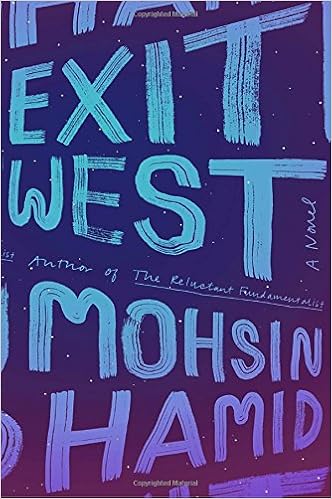
Exit West by Mohsin Hamid


Image result for exit westMohsin Hamid's, "How to Get Filthy Rich in Asia," imitated the style of a self-help book using the rarely used in fiction second person point of view. In "Exit West," Hamid again shows his willingness to take risks in a realistic story that uses metaphors and imagery that gives magical setting transitions a slightly surreal flavor. The magic places the readers' focus on the before and after flight of two immigrants fleeing a Muslim country in an unnamed war to countries that are hostile toward them upon arrival - it eliminates an exploration of the immigrants' journey. This heightened the psychological exploration of the immigrants for me, but some readers might not like the author's splat of magical realism. I listened to the audio book and Hamid's use of repetition and the excellent narrator made it memorable and easy to understand. "Exit West" is layered with many themes and timely as it reflects the current globalization, countries slant toward nationalism, and displacement of people from wars, to name a few. Some might like the romance, or the independent spirit of the female protagonist, different characters' struggles for self-identity, and a myriad of other topics. 


Saeed and Nadia, live in a Muslim country being overtaken by militants. They are progressive and enjoy modern technology until their city becomes overtaken by militants. Day-to-day living is replaced by anxiety and fear causing the retreat of people from public to private spaces to the point that they are afraid to go to funerals. When Saeed's mother is killed by a stray bullet people are afraid to come to her funeral and his father insists that Saeed and Nadia leave the city. Saeed's father will not go with them for he knows he will slow them down and he wants to remain where he's lived his whole life. He recognizes that his son has no future in a city were drones, killings, and bombs oppress everyday living. However, the father feels the past and its memories offer him more than the future and so he stays. The father and son know they may never see each other again.

When Saeed and Nadia immigrate through magical doors (literarily) to a refugee camp in Greece, then London, and the U.S., they encounter hostility from mobs of people who are "natives" that use violence against the newcomers. Saeed and Nadia are oppressed in their new homelands. They try to make their way and find an identity but it is difficult as an outsider. Their experiences show Saeed drifting to people like himself and how he finds comfort in their shared experiences and religion; whereas, Nadia drifts towards diversity and tries other clans. The two experiment with finding their identities. The end of the story shifts toward a romantic narrative and the previous plot tension gets a bit lost as the two go their own ways.

While the story is about migration and marginalization for Saeed and Nadia, it also reveals that people who live in the same place can feel like foreigners in their own city as well. Their home changes around them as can be seen in Saeed's father's lifetime. His city was mostly free and safe before militants started killing civilians and disrupting government operations. Two minor characters who fall in love at the end of the novel show a blending of those who migrate and those who stay in a city their entire life. Even though the immigrant does not know the language, he communicates through hand gestures with the man who has lived there his whole life. They fall in love and are happy revealing positive futures are possible where diverse people can coexist side-by-side without fear and hatred. The suggestion is that society is better or enriched when people can choose to live where they want and call home in whatever country they live. Fear and anxiety stunts not only the potential for an individual to live a full life, but also an entire society's.

Magical doorways are a metaphor for migration, globalization, and technology. The two people pass through doorways to Greece, England, and California. The author doesn't focus on the immigrants' journey; instead he examines where the protagonists came from and what happened after they arrived in their new countries. This exploration of displacement allows the author to focus on the psychology of what the characters are going through as they migrate. Not everyone will like the technique, but I thought the surreal moments enhanced the characters emotional turmoil of adapting to new situations and represented the unnameable displacement a person feels when uprooted from his or her home country. It's a bit like wading through a thick cultural fog.

The magical doorway metaphor reminded me of Skype and how I can live thousands of miles away from my loved ones and yet can see them on a computer and chat, just like a magic mirror in a fairy tale. For me, his book captures the international displacement I feel traveling the world. I haven't been home in twelve years and that seems to be a major point in the book. Not to mention, with technological advancements in computers, transportation and more, migration in today's global world is much more rapid than thousands of years ago.

Doors can also symbolize open and closed nations. Nations can close their borders by fear and wanting to live in the past like Saeed's father. Opportunities are open or closed to immigrants like Saeed and Nadia when they arrive in their new countries. Windows are another metaphor that the author uses that express the future as one with possibilities or not. The window in Nadia's apartment has beautiful views only to have to be covered as the threat of bombs sending shattered glass throughout the apartment grows. She describes the changes from a light apartment to one that is dark and where she and Saeed cower away from the window. There is quite a bit going on in this quick read and I've only touched on a few. I highly recommend it.

5 Smileys

Sunday, April 30, 2017

The Sun Is Also a Star by Nicola Yoon

Students chose this for book club and the snappy dialogue and defined characters make it a well-done interracial romance novel. Set in New York City, Natasha Kingsley, is being deported to Jamaica and trying to find a way to stay in America by contacting the US immigration office. Korean-American, Daniel Bae, is on his way to a college interview for Yale when their paths cross. When the two teenagers meet, the poetic Daniel tries to convince the logical Natasha that love at first sight is possible by asking a series of scientific questions. The author adds historical context that engages the reader whether it is an explanation of why so many Koreans own salons that cater to African Americans, immigration facts, scientific paradoxes, facts, theories, and more. 

Natasha is smart and has a clear view of the world. She won’t be patronized by adults and she’s blunt with people. At the immigration office, an adult tries to tell her the future will work out. “Don’t tell me I’ll be all right. I don’t know that place [Jamaica]. I’ve been here since I was eight years old. I don’t know anyone in Jamaica. I don’t have an accent. I don’t know my family there, not the way you’re supposed to know family. It’s my senior year. What about prom and graduation and my friends?” When Daniel meets Natasha he appreciates her direct, no-nonsense quality. Natasha is so science-driven that she explains the scientific chemicals that are released in the brain when a person falls in love trying to remove all the unexplainable romantic elements. 

Most of the alternating points of view are Natasha and Daniel’s, but there are side characters interspersed to round out the themes of self-identity, culture, love, science, and racism, to name a few. The poetic Daniel describes meeting Natasha and his love-at-first-sight is as follows: “It’s like knowing all the words to a song but still finding them beautiful and surprising”. While Natasha thinks of meeting him as definitely connecting with Daniel, but her practical side sees the moment and distrusts the “poetic heart”. “They’re not talking about the real heart, the one that needs healthy foods and aerobic exercise. But the poetic heart is not to be trusted.” Natasha doesn’t want to fall in love with Daniel.She will be deported in 24 hours. When Daniel saves her life and breaks her pink head phones that she's owned most of her life, it symbolizes her break with the past and all she has known. Her new cultural identity now involves interracial love and living in a new culture. 

While Natasha and Daniel don’t have a problem with their different cultural backgrounds, their family members do. Both struggle with self-identity, while at the same time being self-confident and happy with themselves. They must learn to deal with parental expectations intertwined with different cultures. When Natasha's dad first meets Daniel, his face shows his displeasure. Her dad wants to be an actor but is rejected for roles because of his ethnicity making him insecure and depressed. He misses his home country to the point that he tells a policewomen he is an illegal immigrant. He says that he doesn't know why he did that but it is obvious that he subconsciously wants to return to his home country. 

Similarly, Daniel is dealing with parents who expect him to speak Korean and marry an Asian girl. When Natasha first meets his brother, Charlie, and his dad they make racist comments. The brother brings up the stereotypical African American that shoplifts and the dad tells her to buy some relaxer because her hair is too big. Natasha responds that she likes her big hair and Daniel responds to his brother by giving him the finger. Both Natasha and Daniel are confident with themselves even though life is uncertain; whereas, the parents of both have to deal with disillusionment and unhappiness.  The feelings of alienation for immigrants is captured in the complexity of finding not only self-identity but an American or Korean or Jamaican identity as well.

Another motif explored from Daniel’s point of view is names. Daniel’s mom ponders that America names signify the individual; whereas, Korean names point to the importance of family ancestry. Daniel’s mother “agonized” over what to name her children showing her struggles with cultural identity. She decided on both American and Korean to show them where they’d been and where they were going. Daniel’s brother Charlie, however, with all his intelligence doesn’t understand the power of his past and tries to erase all that is Korean in him. He’s on probation from Harvard college and Daniel reveals that when he is grown-up and has a good job he goes by Charles Bay not his given, Charles Jae Won Bae. He refuses to speak Korean, eat Korean food, or date a Korean. This prevents him from finding true happiness in life because he doesn’t like himself and is rejecting part of his cultural identity. The result is a shallow, alienated, and self-absorbed character who is unable to have a close relationship in marriage or with family members. 

The ending is a bit convenient or forced regarding how the two meet, but it will satisfy the romantic heart. Or should I say, "poetic heart". I particularly like how this author puts words together. The cadence and rhythm of the chapters make it fast-paced and the back-and-forth dialogue between Daniel and Natasha is funny and smart. I did try the audio tape first but sort of lost track of who was speaking. I switched to the book and got more out of it in the end. But since listening is my weakest learning style, I'm biased. A fun, well-written, and enjoyable book. 


Wednesday, February 8, 2017

American Born Chinese by Gene Luen Yang

This interesting graphic novel takes three seemingly different stories and weaves them together in a story that shows the struggles of what it is like growing up in a country as a teenage immigrant and trying to fit in. The first story is a 500-year-old Chinese myth about the Monkey King. This arrogant monkey thinks that he is a god and learns humility and caring for others after getting knocked down. The second story is about a young Asian boy in love with a white girl, but afraid to ask her out. And the last is about a white boy that has to tolerate his cousin portrayed deliberately as a negative Asian immigrant stereotype. The three stories come together in an unlikely way that uses visual and print images to convey messages about immigrants, stereotypes, identity, bullies, and love. The author packs a lot into this book that only took me an hour to read.

Yang takes the Monkey King fable and presents a cocky monkey that tries to become immortal only to have the creator bury him under a mountain of rock. The god-like creator of human beings, Tze-Yo-Tzuh, is a mix of East and West religions, similar to the Christian God and the Taoist, Lao-Tsu. The Monkey King does not free himself until he learns to accept his identity and humble himself.

The second story is about an Asian boy that desperately wants to fit in with other students at school. He perms his hair and avoids the other Asian students until a new boy shows up from China. The Asian boy betrays their friendship and has to make amends. The third story is about a white boy with an Asian cousin who embarrasses him with his immigrant accent, looks, and behavior.

In comics and films, negative Asian stereotyped characters were often presented as wearing a type of sedge hat, having buck teeth, slanty eyes, and a ponytail. The "coolie", a derogatory term for a manual laborer, was usually the sidekick to the white hero. Yang's character is reminiscent of characters such as Chop-Chop, Yellow Peril, and Fu Manchu. Or maybe the immigrant Siamese Twins in Chip-n-Dale's Rescue Ranger with their bad accents are closer to the mark. Either way, I had no idea where Yang was going with the plot on this third story. The first two are about identity and trying to fit in but the third was offensive in its caricature. Yang creatively works this into the plot with a terrific ending - don't worry, I won't give it away. Another winner by the talented artist.

5 Smileys