Pages

Showing posts with label war. Show all posts

Monday, July 3, 2017

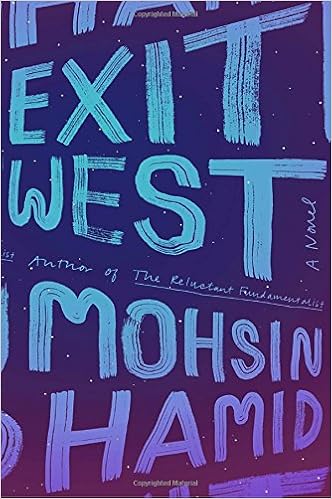
Exit West by Mohsin Hamid


Image result for exit westMohsin Hamid's, "How to Get Filthy Rich in Asia," imitated the style of a self-help book using the rarely used in fiction second person point of view. In "Exit West," Hamid again shows his willingness to take risks in a realistic story that uses metaphors and imagery that gives magical setting transitions a slightly surreal flavor. The magic places the readers' focus on the before and after flight of two immigrants fleeing a Muslim country in an unnamed war to countries that are hostile toward them upon arrival - it eliminates an exploration of the immigrants' journey. This heightened the psychological exploration of the immigrants for me, but some readers might not like the author's splat of magical realism. I listened to the audio book and Hamid's use of repetition and the excellent narrator made it memorable and easy to understand. "Exit West" is layered with many themes and timely as it reflects the current globalization, countries slant toward nationalism, and displacement of people from wars, to name a few. Some might like the romance, or the independent spirit of the female protagonist, different characters' struggles for self-identity, and a myriad of other topics. 


Saeed and Nadia, live in a Muslim country being overtaken by militants. They are progressive and enjoy modern technology until their city becomes overtaken by militants. Day-to-day living is replaced by anxiety and fear causing the retreat of people from public to private spaces to the point that they are afraid to go to funerals. When Saeed's mother is killed by a stray bullet people are afraid to come to her funeral and his father insists that Saeed and Nadia leave the city. Saeed's father will not go with them for he knows he will slow them down and he wants to remain where he's lived his whole life. He recognizes that his son has no future in a city were drones, killings, and bombs oppress everyday living. However, the father feels the past and its memories offer him more than the future and so he stays. The father and son know they may never see each other again.

When Saeed and Nadia immigrate through magical doors (literarily) to a refugee camp in Greece, then London, and the U.S., they encounter hostility from mobs of people who are "natives" that use violence against the newcomers. Saeed and Nadia are oppressed in their new homelands. They try to make their way and find an identity but it is difficult as an outsider. Their experiences show Saeed drifting to people like himself and how he finds comfort in their shared experiences and religion; whereas, Nadia drifts towards diversity and tries other clans. The two experiment with finding their identities. The end of the story shifts toward a romantic narrative and the previous plot tension gets a bit lost as the two go their own ways.

While the story is about migration and marginalization for Saeed and Nadia, it also reveals that people who live in the same place can feel like foreigners in their own city as well. Their home changes around them as can be seen in Saeed's father's lifetime. His city was mostly free and safe before militants started killing civilians and disrupting government operations. Two minor characters who fall in love at the end of the novel show a blending of those who migrate and those who stay in a city their entire life. Even though the immigrant does not know the language, he communicates through hand gestures with the man who has lived there his whole life. They fall in love and are happy revealing positive futures are possible where diverse people can coexist side-by-side without fear and hatred. The suggestion is that society is better or enriched when people can choose to live where they want and call home in whatever country they live. Fear and anxiety stunts not only the potential for an individual to live a full life, but also an entire society's.

Magical doorways are a metaphor for migration, globalization, and technology. The two people pass through doorways to Greece, England, and California. The author doesn't focus on the immigrants' journey; instead he examines where the protagonists came from and what happened after they arrived in their new countries. This exploration of displacement allows the author to focus on the psychology of what the characters are going through as they migrate. Not everyone will like the technique, but I thought the surreal moments enhanced the characters emotional turmoil of adapting to new situations and represented the unnameable displacement a person feels when uprooted from his or her home country. It's a bit like wading through a thick cultural fog.

The magical doorway metaphor reminded me of Skype and how I can live thousands of miles away from my loved ones and yet can see them on a computer and chat, just like a magic mirror in a fairy tale. For me, his book captures the international displacement I feel traveling the world. I haven't been home in twelve years and that seems to be a major point in the book. Not to mention, with technological advancements in computers, transportation and more, migration in today's global world is much more rapid than thousands of years ago.

Doors can also symbolize open and closed nations. Nations can close their borders by fear and wanting to live in the past like Saeed's father. Opportunities are open or closed to immigrants like Saeed and Nadia when they arrive in their new countries. Windows are another metaphor that the author uses that express the future as one with possibilities or not. The window in Nadia's apartment has beautiful views only to have to be covered as the threat of bombs sending shattered glass throughout the apartment grows. She describes the changes from a light apartment to one that is dark and where she and Saeed cower away from the window. There is quite a bit going on in this quick read and I've only touched on a few. I highly recommend it.

5 Smileys

Wednesday, December 28, 2016

The Pentagon's Brain: An Uncensored History of DARPA, America's Top-Secret Military Research Agency by Annie Jacobsen

I listened to the audiobook while traveling 32 hours (door-to-door) from Africa to the U.S. The audio, narrated by the author, was over 18 hours and never failed to put me to sleep. Bulging with fascinating details, it lulled me to sleep with all its names and acronyms at times, but kept me awake other times. The beginning is an amazing account of the hydrogen bomb that mades me wonder about the after-effects in the islands decades later.

I recommend the book over an audiobook unless you have a good memory for details. I don't. I am going to get the book and skim it again. An ambitious look at a little-known, yet powerful agency, started in the 1950's to win wars. Annie Jacobsen does a good job dramatizing historical events and remaining objective letting the reader decide whether DARPA crosses the line or defends the country in its mission. I can see why this was a 2016 Pulitzer Prize nominee for history.

The arms race between the Soviet Union and the United States meant the belief in "mutually assured destruction" - nations attacking each other with nuclear weapons would destroy themselves in the process. The U.S. decided to develop DARPA in 1958 to stay ahead of the Soviets in new arms and technology, and prevent a nuclear strike. The department developed cutting-edge technological, biological, psychological and scientific warfare. They developed ARPANET, the pre-cursor to today's Intenet, and Agent Orange, a toxic defoliant used in the Vietnam War. Sophisticated rifles, drones, and global positioning systems (GPS) make this read like a spy novel at times.

One reviewer, Richard Easton, claims that the information on GPS is incorrect. He's quite detailed in what he considers egregious errors. I would have to do more research in this area to see if I agree or not. I do not agree that the entire book is a wasted effort if that is true as he implies. The GPS is a small portion as the author is covering the entire DARPA history. However, if Jacobsen is wrong, I hope it is corrected in new printings. I hope her book leads to more work on the topic. She wrote it by interviewing 71 former DARPA scientists and reading newly declassified documents from 1958 to the present. It is quite fascinating and original.

5 Smileys

Tuesday, May 24, 2016

Pax by Sara Pennypacker, Jon Klassen (Illustrations)

This story is bound to no particular time and place and reminds me of Aesop's fables with its moral at the end. A lack of setting is common in fables and allows readers to relate the moral to their own place or situation. Sara Pennypacker's book, "Pax," uses this technique. It is set in a place where humans are at war and the animals are victims as much as the people. When Aesop was in Greece he used the fable to voice his opinions that were leveled against those in power. Here the fable is leveled at adults in authoritative positions or that control children. Several characters reveal the choices they make in life; whether they choose right from wrong and recognize when to take a stand against a person or institution. While I found the start hard to get into, I did get engrossed once the character, Vola, was introduced and the book's style became clear. This is definitely original and Pennypacker has great sentence fluency. Her turn of phrase and word choice shows an author that knows her craft. The rich layers of meaning will lead to many discussions.

Twelve-year-old Peter is forced by his dad to abandon his pet fox when his dad enlists in the war. The two are on their way to grandpa's house who is going to care for Peter while his dad is gone. Once Peter arrives, he runs away determined to retrieve his fox whom he has had for five years just after his mother died. The three-hundred mile journey to retrieve the fox is full of obstacles. Peter gets help from a woman, Vola, who has abandoned the world after serving in a war twenty years earlier that left her with post-traumatic stress disorder. The voices alternate between Peter and Pax, his fox.

The lack of setting and slow character build-up made me slog through the beginning. I didn't really figure out that I should be reading it as a fable until page 66 when the gray fox makes comments about humans being careless in war and destroying animals in the process. It is also a coming-of-age book as Peter loses his childhood innocence making decisions on his own and contemplating the effects of deceit internally and with Vola. They discover the difficulty of facing the truth about themselves. The author shows the adults as being "war-sick" and destructive toward animals and humans. Peter's dad abandons him just like Peter abandoned his fox.

Peter's loss of innocence is shown from the fox's point of view. He tells the female fox, Bristle, about how Peter has become false-acting. He tossed a toy deceptively getting Pax to think they were playing a game but then drove off in the car. However, Pax makes a point to tell Bristle that Peter is not war-sick like the adults. He is not full of hate or anger  and wants to destroy, but can show love. Peter knows it was wrong to let Pax go like that and while he recognizes that his dad didn't give him a choice he feels guilty for not standing up to him and insisting Pax stay. He is trying to make it right.

Peter's point of view shows him learning to live without the fox and face his grief and guilt over losing his mother. Peter blames himself for an accident he had with his baseball bat the last time he saw his mom. This parallels Vola's story of grief and loss as well. "He was becoming foxless, something he'd hadn't been since he was seven years old." Losing Pax was like losing his mother all over again. He and Vola both help each other deal with their losses. 

There are many symbols in the book from the Phoenix to the marionettes to the names given the characters or words spoken. The wooden bat was the most powerful one for me with its imagery of hitting, acting as a crutch, bringing him joy in a sport, and made of wood like the marionettes. He and Vola are like Geppetto and Pinnochio in their carving shop. Much of the storyline follows the destructive path of anger and how it can be productive if directed in a proper way. Vola tries to help Peter understand the difference as he feels that all anger is destructive and tries to hide from his own true feelings rather than face it. The story has great character development along with symbolism even if the setting confused me.

Fables convey an idea indirectly rather than specifically and this is evident in the moral that is stated at the beginning, "The apple doesn't fall far from the tree," and the end, "Sometimes the apple rolls very far from the tree." The idiom means that children are like their parents. The moral is children do not have to be like their parents, as well as, shows that all humans can make a choice in their attitude. The men in Peter's life choose to be angry and undemonstrative. They choose to hit rather than hug. Peter consciously chooses to love and knows what it means at the end when he gives his pet freedom. The desire for freedom is universal and has fueled many wars. While I struggled a bit getting through this, it was worth it in the end.

5 Smileys

Thursday, May 19, 2016

Samurai Rising: The Epic Life of Minamoto Yoshitsune by Pamela S. Turner

I made the mistake of reading this book thinking it was fiction, but it is historical nonfiction. Because it takes place in the 12th century there is not much dialogue. Sixty pages of footnotes including the dialogue the author show the difficulty of mixing fact with legend, but Turner handles it well. She adds her own humor making this adventure story hard to put down. I'll be surprised if she doesn't win some nonfiction award.

I got lost in the story once I stopped looking for a fiction narrative. The story begins during the time of Japanese history when the samurai took control of the government from the Emperor, making the royal family more of a figurehead than the controls. Two samurai clans, the Taira and Minamoto, fought for control with the Taira taking the emperor hostage and brutally chopping down rivals. They let the baby Yoshitsune survive who lived with the monks before running away as a teenager to become a samurai warrior. His legendary, reckless military tactics helped his brother overthrow the government in a civil war that lasted five years. Yoshitsune was a brilliant strategist and won some critical battles defeating the Taira clan, but he was arrogant, headstrong, and politically ignorant alienating top commanders. His brother,Yoritomo, felt threatened by his popularity and other commanders fed his suspicions.

The legend plays out like a tragedy with the brother, Yoritomo, gaining complete power and sending assassins to kill Yoshitsune who ironically was the reason he had so much power. Yoritomo's suspicious nature and fear of losing power led to him killing off almost all of his loyal followers throughout the years leaving his family and relatives unprotected after his death and easily killed by rivals. This reminds me of Stalin who killed off those closest to him and any who questioned his policies. Yoritomo was an excellent politician who gave into his fears once he became all-powerful.

Yoshitsune was critical to winning several battles as a hit-and-run commander. He'd lead small bands and cause chaos among the enemy. He was a skillful horsemen and had good fortune on the sea driven by confidence. However, his lack of naval experience later in life caused him to make a critical mistake at sea that cost him the chance to rise up against Yoritomo. Throughout his life, Yoshitsune's impulsive, arrogant attitude made him fearless in war but showed he did not have the political experience or foresight to determine possible moves by his enemies. He didn't seem take notice of who he angered or slighted as his superiors and in the end this cost him his life.

History shows different definitions of heroes in cultures. The Vikings hero was a loyal, courageous, aggressive, and scornful of death. They dominated in military strategy on the seas. The samurai were courageous, not afraid to die, and excellent swordsmen. However, the Taira clan was best at sea and the Minamoto clan was best on land with horses. Yoshitsune used this to his advantage in warfare. Samurai were not loyal and would switch sides easily. The society had stratified classes with the commoners at the mercy of those in authority over them. They did not have rights and the samurai, wealthy, and elite had no problem killing commoners in their way in their quests for power. Students will like this book with its focus on martial arts, warfare, heroes, and conquest.

5 Smileys

Tuesday, October 27, 2015

MiNRS by Kevin Sylvester

Science fiction over the years has reflected the fears and concerns of society. In the 50's, 60's, and 70's there was hype over landing on the moon and exploring space, the fear of alien invasions and nuclear war. The cold war fizzled in the 90's and the war on terrorism and technology exploded. Books such as "Fahrenheit 451," by Ray Bradbury reflected fears over the invention of the television while more recent novels like, " Hunger Games," by Suzanne Collins mirrored reality-TV shows and the Iraqi war. From biotechnology to artificial intelligence, science fiction dances across a gamut of topics exploring scientific, political, and social implications in a speculative society. Kevin Sylvester's book, "MiNRS," shows the political ramifications of one company controlling resources needed by a future Earth that has been destroyed by humans. When a war breaks out, the story unfolds from the viewpoint of one boy who is trying to survive and make sense out of violence.

Christopher Nichols appears like a typical kid, going to school and thinking about homework while adults run a mining operation for metals and minerals in his town-like setting; however, there is one itty-bitty detail that is far from typical... Christopher's "town" is a small space colony plopped on the asteroid named, "Perses." For a kid with a slant toward science and math, his life is not only cool, he absorbs the information and world around him like a hygroscopic substance. Perses threatened to collide with Earth until a scientist, Hans Melming, was able to use rockets and gravity to propel it into a habitable part of orbit. He terraformed the planetoid's surface and sent up humans to mine the ore. About twenty children live on Perses and Christopher is one of them.

As time passed, Earth depleted its resources and left Melming Mining Company with the golden rod or rock of invaluable resources. The colony seems unaware of the target on its back but some are worried, like Christopher's parents. Christopher has everything he needs and leads a privileged life with his parents who work as supervisors at the mine. He idolizes Melming and every year the school watches a propaganda movie about the great contributions Melming has made to the survival of Earth.

The inhabitants on Perses are readying for a blackout caused by solar interference and know that communications with Earth will be knocked out for a month. The colony is protected by the Melming Mining Company from Earth but the blackout means no protection or warnings. Their worse fears are realized when they are attacked by "Landers," an unknown group from Earth, intending to steal the ore. They bomb the facility and the adults are killed with only a few children able to seek shelter underground. Christopher's mathematical and scientific brain immediately goes into survival mode and makes plans. His parents had a backup plan if something went wrong during the blackout, except the plan was in code and Christopher is having a hard time deciphering it. With the aid of his friend, Elena, the two seek help from Earth and retaliate against the Landers.

Futuristic or science fiction novels speculate what the world would be like in a different setting. A common trope in these novels is an authoritarian government that is in control with a naive protagonist that accepts the status quo. The government is seductively attractive until the protagonist unravels serious flaws in the system. Such is the case as Christopher believes the propaganda at first before slowing realizing that all is not idyllic. Others are in forced labor and oppressive conditions but this has been hidden from the 20 children. When discovered, most of the other privileged children don't see what is wrong with it but slip into superior, prejudiced views that do not value other human beings. As Christopher's ideal world is exposed to harsh realities, he has to choose right from wrong and it is these internal battles that give the novel depth. Not only is Christopher dealing with problems on a personal level, but he has to analyze and think critically about the political and social issues of how the asteroid was governed and maintained by the adults.

The surviving children are suffering from post-traumatic stress syndrome. They have seen family members blown up by bombs and shot at and respond in different ways. Elena tries to take comfort in military strategies and attacking the enemy. Christopher makes plans and tries to think of the survival of the group. Another character cares medically for the others, while another hoards food. Everyone reacts differently to traumatic events and it adds to the authenticity of the characters. The attack and subsequent deaths are traumatizing making it difficult to move forward each day.

The world-building is well-done and not so scientific that young readers can't follow it. The reader never discovers who the enemy is and the end suggests that the government is seriously messed up down on Earth. I wanted more back story but enough was given to tease me along. While I would normally want to know who the attackers are rather than have these faceless, pirate villains that never interact with anyone, I didn't think it detracted from the novel. I think it was left out to entice the reader to the sequel, but I would have preferred more clues as to who the Landers were that so violently attacked Christopher's community.

The subplot of Christopher's budding romance with Elena adds another emotional element to the story, but is not overpowering. Elena's jealousy of the grinder is never realized in this novel and the cliff-hanger ending leaves more than just that question. The adults that Christopher thinks he sees raises new questions as well. This reminds me a little of the book "Shipbreaker," but less violent. Not that this one isn't. It is. The action adventure will appeal to many of my students along with Christopher's ability to use math and science to survive in dire circumstances.

5 Smileys

Monday, July 27, 2015

Listen, Slowly by Thanhha Lai

Anyone that has braved the streets of Vietnam knows the thrill of linking arms and shuffling across the asphalt as cars swerve around bodies like rocks in the middle of a roaring stream. Honest. It is quite the experience. The author captures this unique cultural feature and so much more as Mai, a first generation American born girl, learns about her heritage on a vacation with her grandma to Hanoi, Vietnam. Not that twelve-year-old Mai is looking for any cultural roots. "OMG," she's looking for love "with HIM", while hanging at Laguna Beach with her best friend over summer vacation. Her plans and romantic ideas simmer in the hot sun until her parents douse her with reality making her travel with her Grandma Ba to Vietnam because Ba has new information regarding her husband who went missing during the "THE WAR." Mai's dad goes with on the trip, but he is a doctor whose first priority is to help children in Vietnam's remote areas in need of medical services. Mai's mom is a lawyer on a big case and both insist Mai escort Ba. The parents want Mai to know her heritage. Mai's  knowledge has some humungous gaps considering she refers mainly to what she learned from watching a PBS documentary on the Fall of Saigon. Mai says she is "unicultural"; but this trip changes Mai teaching her what it means to be bicultural, enriching her life in ways she never expected.

Mai matures in small increments. She's spoiled, privileged and has a snarky attitude that is hilarious and balanced by a kind heart. She will do something nice followed by a "I rock!" She loves her Ba completely and will do anything for her, "I'm now too tired to yawn but I still rock as her caretaker, asking if her throat is sore." In the beginning all Mai can think about is leaving Vietnam as fast as possible, but she starts to empathize with Ba and appreciate Vietnam. Ba is one of the few adults that Mai listens to: "My body loosens and expands, remembering how it used to make room for her words to wiggle deep into the tiny crevice alongside my bones, muscles, and joints. Becoming a part of me." Ba is the eloquent character in the group, a foil to Mai's egocentric voice. The title of the book comes from one of my favorite passages as Ba describes dealing with the loss of a loved one to Mai, "I tell you of loss, my child, so you will listen slowly, and know that in life every emotion is fated to rear itself within your being." In our fast-paced world, listen slowly, can take on many meanings.

Mai struggles with learning the language bemoaning, "...she [Ut] doesn't understand my non-Frenchy English. It's exhausting but so is my life." She calls her attempts to communicate, "Tarzanish Vietnamese." She's impatient and strong-willed making for a strong female character. When the detective shows up, she hates it when adults take forever to get to the point. "OMG, what are the chances of me meeting the second wordiest human on the planet?" Or she attributes all the building designs to one architect. "Now that I'm no longer shocked by the maneuvers of every moped I notice that just about every house is built in the stacked style like Co Hanh's. It's confirmed. One architect designed for the whole country." Mosquitoes love her sugary blood and she goes to war with them after being turned into their pincushion. Funny observations such as the "doll-sized" food portions and "How am I supposed to get beyond lanky in a land where ice cream is made of red beans instead of cream?" That's not exactly true but Mai likes to exaggerate for a laugh. And boy, did I laugh a lot. She also captures the overcrowded roads in Asia with comments like, "...let me enjoy my cloud of toxic fumes from thousands of lawless mopeds in peace." She pulls some shenanigans on the women regarding thongs and starts to make friends with Ut, having far more exciting adventures than she would have at Laguna Beach.

Mai thinks of nothing but going home as fast as possible. She tries to manipulate events and others to make it happen, but later starts to adjust to her new culture and cousins. Ut is a strong-willed, frog-obsessed cousin who shaved her head - her reason is funny because it is practical but mortifies her beauty-obsessed mom - and she stands up to Mai's snobbish ways changing Mai's outlook in the process. The two develop a friendship where they respect and don't try to change each other. When Ut argues over 40 cents bargaining for food, Mai silently bargains behind her back so Ut thinks she got a good deal and Mai gets the food she wants. Mai wonders why everyone knows English better than she knows Vietnamese. Ut helps Mai along with the serious translator, Ahn Min, whom Mai can't resist poking fun at all the time.

Mai loves drama. In a subplot she whines that her love triangle in California is being replicated in Vietnam. In California, Mai and her best friend are interested in the same guy. She can't say his name because she has such a crush and refers to the boy as "HIM." By the end Mai has matured enough to say his name and not be so dramatic about talking to him. Ahn Min, her translator in Vietnam, is interested in another girl but a different girl is interested in him and thwarts his effort to get her attention. I am not sure how this ties in with the overall theme of a girl finding her heritage, but it does show Mai growing up and processing her crush on a boy and that people are the same and have the same basic needs regardless of where they live in the world. Some funny and memorable episodes happen during this part.

The author captures the frustration of learning a new language and how difficult it can be to communicate. Mai calls words she doesn't understand "ghost words." This imagery reminds me of Buddhism and how worshipers follow the "ghost" month where dead ancestors are allowed to spend a month visiting families, feasting, and finding victims among the living. Buddhism is the largest religion in Vietnam even though the government has periodically tried to extinguish it. When Mai goes to Saigon to locate the guard, she speaks sentences using Vietnamese mainly out of frustration and desperation. She's thrilled when this happens and the Vietnamese man understands her. Afterwards her usual cocky attitude comes back loud and clear, "I'm now officially bilingual and can rule the world!" It doesn't last long though. Pretty soon "The detective yells at us, using python sentences that strangle the air." What a great description of what it is like learning a language. 

Mai pokes fun at cultures and conventions in the United States and Vietnam.  They don't hug each other in Vietnam and Mai forgets many times hugging her relatives when she is happy. They seem to like it. Even Ut, although she swats her in response out of embarrassment. It is one of many instances where Mai shares her culture with her cousins or vice versa. This is the excitement of learning a new culture and sharing differences in a healthy way. Mai also diplomatically refers to the past fighting as "THE WAR." In Vietnam it is called, "The American War" and in America it is called, "The Vietnam War." Her neutral stance avoids the name controversy and shows the war for what it was, a bloody war between two countries. Mai jokes about food, sizes, architecture, and clothes. "I don't know anyone here to care what I wear, much less how often and what brand. It's freeing." She's also such a teen with an egocentric attitude. "I'm so bored, the kind where you bite off all your nails and wish they'd grow back instantly so you could bite them again." She's a hoot. Learning about heritage and other cultures has slowly changed my views of the world and exposed my biases and stereotypes I didn't know I had. I'm trying to listen slowly.  Don't miss this winner.

5 Smileys


Tuesday, May 19, 2015

Mars Evacuees by Sophia McDougall

Alice Dare takes life in strides. Aliens taking over the planet. Whatever. Parents fighting in the war. Check. She has never known life to be any different. The war has been going on for fifteen years. She rarely sees her parents and has to live at a boarding school. When she finds out she's being evacuated to Mars to be trained as a fighter she thinks, "...I'd gotten a general idea of my future a long time ago, and whether I liked it or not, it was always going to involve shooting things." Her biggest issue is trying to live up to her hero mother, a famous fighter pilot in the war and worrying that her parents will be killed. Alice has one misadventure after another. They pile up on her and her friends and they keep tackling each one with optimism and spunk.

This reminds me of living overseas. So many things go wrong. I just bought a mystery tea and thought it was green tea. No, I can't read Chinese. Nothing like the runs before I run tonight. VISA's get messed up, items get stolen or lost, strange foods make you ill, you have different medical procedures, you face some prejudice, your bad attempts at learning the language are laughed at over and over, and so on. But in the end, it is one grand adventure that gives you plenty of memories and stories to talk about with family and friends. And then there is the joy of learning a new culture and making new friends just like Alice does in this book.

Twelve-year-old Alice Dare has a name adults mispronounce as "Alistair." Earth has been overtaken by aliens called, "Morrors." Humans are attempting to colonize Mars as they are losing the war against the aliens and Alice is on her way there to be trained as a soldier with 300 other children ages 7-18. I wondered if this was going to be an "Ender's Game," but it isn't. More "Lord of the Flies," but I'll get to that. On the Mars flight, Alice makes friends with Josephine, a genius that wants to be a scientist not a soldier. She meets the hyperactive, pilot-prodigy and theatrical teenager, Carl Dalisday, and his younger brother, Noel. Everyone expects Alice to be a great pilot like her mother but she discovers her talents elsewhere. When the adults disappear from the space station, the three hundred children take over the space station with bullies beating up others to force them to do what they want. Alice high-tails it out of there with her group of friends in search of the adults.

Their adventure leads them through treacherous terrain where they discover another alien that threatens not only them, but the Morrors. When they make friends with a teenage Morror, Thsaa, the group learns to bridge differences and get the adults to work together in face of an enemy that will not only annihilate them both, but will destroy Earth. Overcoming their fears and prejudices, Alice's group and Thsaa become friends and help the adults work together. If an enemy is going to take over the planet do you commit genocide and have one species destroy the other or do you try to coexist? Whereas, "Ender's Game," goes the genocide route, this book takes the coexistence route when faced with interstellar war.

Alice's voice comes out strong at first, but then I thought it got lost during the "Lord of the Flies" segment. Josephine wants to leave and Alice wants to organize everyone to work together. Alice was having issues with bullies from the get-go and is presented as a person that likes to stay out of the limelight, so I was surprised she tried to get kids to team up. The author never really goes back to that subplot and it felt unfinished to me. She gives a tiny wrap up but I would have liked a bit more. It doesn't matter overall, but I didn't think it fit in the plot as smoothly as other elements. Once the group takes off from the space station, so does the action and the nonstop problems they need to overcome. They have to use their wits to survive and each has a unique skill that helps them work together. Alice shows her resilience all along.

Take note that there is more swearing in this book than I normally see in middle grade novels. The aliens also speak a gobbledygook language, but its not hard to figure out what they mean. It definitely gives the characters an alien culture and the fact that they can have up to five parents was funny. Josephine and Thsaaa make connections through art that helps them appreciate each others culture. Before that moment they were putting each others cultures down. Thsaaa didn't like the food, planes, weapons and vice versa. Leapfrog through low gravity in this fun read.

3 Smileys